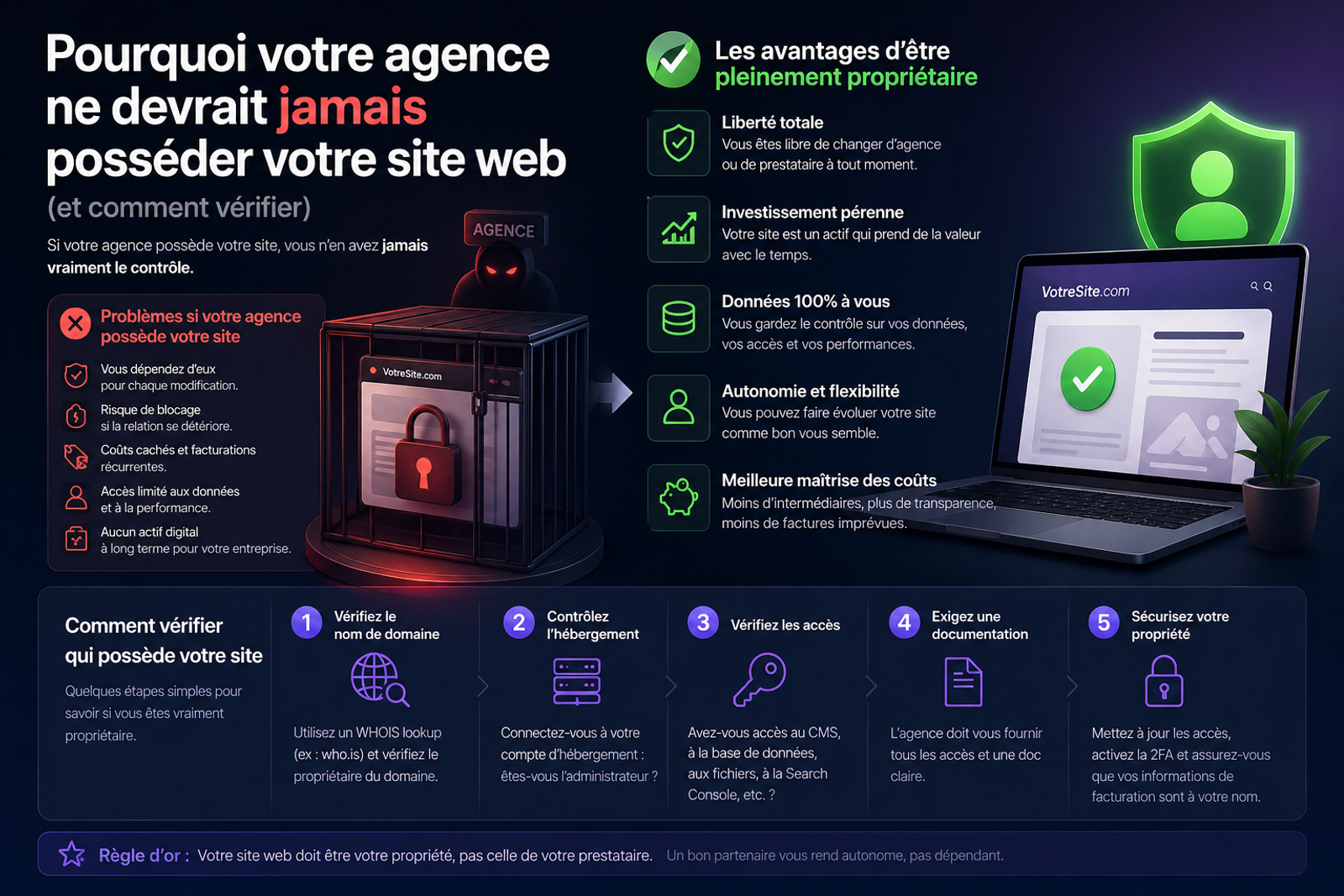
There's a question every business owner should ask their digital agency, but almost no one does:
"Whose name is on the domain registration?"
If you don't know the answer—or worse, if it's the agency's name and not yours—you have a problem. A serious one.
## The hidden truth most agencies won't tell you
Under French law (and most jurisdictions), the agency that builds your website automatically holds the intellectual property rights to the code—unless your contract explicitly transfers those rights to you. The same applies to domain names: whoever registers them legally owns them.
This isn't a hypothetical risk. It happens regularly:
- An agency goes out of business and your domain expires
- A dispute arises and your provider holds your site hostage
- You want to switch agencies and discover you can't
- An employee leaves the agency with the only access to your hosting
The result? Years of SEO work, brand equity, and customer relationships—gone.
## What you should own (always)
When you work with a serious digital partner, you should own:
1. **Your domain name** — registered in your company's name, with you as the administrative contact
2. **Your hosting account** — billed to your card, accessible with your credentials
3. **Your codebase** — delivered in a Git repository you control
4. **Your advertising accounts** — Google Ads, Meta, TikTok, all in your name
5. **Your analytics data** — Google Analytics, Search Console, owned by you
6. **Your CMS access** — admin credentials in your hands
If your current agency holds any of these on your behalf, you don't have a partner. You have a hostage situation waiting to happen.
## How to verify your situation in 5 minutes
Run a WHOIS check on your domain. Go to whois.domaintools.com and enter your domain name. Look at the "Registrant" field.
- ✅ Your company name? You're safe.
- ❌ Your agency's name? You don't actually own your domain.
- ❌ "Privacy protected"? Demand to see the actual registrant data.
For your hosting, log into your provider's dashboard. If you can't, your agency is gatekeeping access to infrastructure that should be yours.
## The questions to ask any agency before signing
Before you start a relationship with any digital provider, ask:
- "Will the domain be registered in my company's name?"
- "Will the hosting account be in my name and billed to my card?"
- "Will I receive the full codebase in a Git repository?"
- "Will the ad accounts (Google, Meta) be in my name?"
- "What happens if we end our relationship—what do I keep?"
If they hesitate on any of these, walk away.
## How we work at Multimedigital
When we onboard a client, the first thing we do is set up infrastructure that belongs to them:
- We register their domain in their company name
- We create their hosting account on their billing
- We push the code to a Git repository they own
- We set up ad accounts under their name
- We share Google Search Console and Analytics access with them as primary owners
The result: from day one, our clients have full sovereignty over their digital infrastructure. If they ever decide to leave us, they keep everything. No hostage situation, no hidden costs, no legal grey zone.
This is what we mean when we say "transparent by design." It's not a marketing slogan. It's the operational foundation of how we work.
## The bottom line
The best agencies in 2026 don't profit from client lock-in. They profit from delivering measurable results that keep clients coming back willingly.
If your current agency owns your domain, your hosting, or your data—it's not a partnership. It's a dependency. And you deserve better.